A Capitol Forum investigation has found that the iLet Bionic Pancreas, an automated insulin delivery (AID) device produced by Beta Bionics (BBNX), is pushing some users into dangerous hypoglycemic events, with some patients ending up in the hospital and developing life-altering conditions because of the pump. Interviews with former employees, users of the device, and an FDA inspection indicate that the iLet’s insulin-dosing algorithm may be inherently too aggressive for some users.
The risk posed by the device administering excessive insulin is complicated, sources said, by the fact that users have very little input in the device’s calculations. Users can only input their weight initially and then log whether they have recently eaten either a small, medium, or large meal; the iLet is designed to handle all the dosing calculations.
“The iLet needs only one number – your weight,” the company’s website states. “It makes the decisions for you.”
“We marketed it as a self-driving car,” one former sales representative said. “But it is not that at all, and whenever something went wrong, there’s little the user can do to correct it. They always wanted to blame the user or the doctor, but those two things can’t be true at the same time.”
Jill, a Type 1 diabetic, told The Capitol Forum that she was surprised by how little information the iLet asked of her.
“I’ve been T1 since 1986, with nearly 40 years of knowledge about how my body reacts to insulin. It takes around 21 minutes for my body to absorb insulin, and it stays in my system for over four hours. But it was dosing like my uptake was much quicker, and it was just stacking insulin on me.”
“One time I woke up and it had given me 18 units of insulin in a 2-hour period. That’s more than I do in a whole day,” Jill continued. “I had to eat like 2000 calories to get enough carbs to raise up my blood sugar. I gained 20 pounds in a few weeks from feeding the excessive automatic insulin delivery.”
While Jill was only on the iLet for a little over a month, the device sent her into several severe hypoglycemic episodes that could have been deadly, and she ultimately developed insulin neuritis, a painful nerve condition, as a result of the excessive insulin administered by the pump.
An FDA inspection of Beta Bionics facility, which The Capitol Forum obtained through a Freedom of Information Act request, indicated that the company was underreporting and failing to investigate thousands of incidents of hypoglycemia, among other device problems. In some internal investigations into hypoglycemic episodes, the company labelled the root problem as either user error or the user’s “understanding of how to manage their diabetes on the iLet” despite the promises of minimal user input.
As a result of the observations of that inspection, Beta Bionics began uploading thousands of reports to a publicly accessible database. An analysis of those reports indicates that the iLet has rates of hypoglycemia that far outpace competitors.
Beta Bionics did not respond to a request for comment for this article.
Dual-hormonal algorithm, but insulin-only device. As the name suggests, the iLet Bionic Pancreas was intended to mimic the processes of the human pancreas, which primarily maintains blood sugar levels by releasing two hormones: insulin to lower blood sugar, and glucagon to raise blood sugar.
For people with diabetes, a healthy blood sugar range is generally between 80 and 130 milligrams/deciliter (mg/dl) before meals, and under 180 mg/dl after meals. Severely low blood sugar (hypoglycemia) can risk seizures, coma, and death, while severely high blood sugar (hyperglycemia) exposes the patient to similar risks as well as long-term debilitating effects such as blindness and kidney failure.
Unlike traditional insulin pumps, which only release insulin, the iLet was originally intended to release both insulin and glucagon to maintain healthy blood sugar levels.
Storing and administering glucagon in the iLet, however, proved unfeasible for humans and the iLet launched as an insulin-only device in 2023 after receiving FDA approval; Beta Bionics is still working on a dual-hormonal pump, known as the iLet Duo. Currently, the iLet delivers both basal insulin, which maintains background glucose levels, and bolus insulin, which is calculated to counteract increased blood sugar levels after meals.
According to former employees who worked at Beta Bionics, the removal of the glucagon component largely threw the iLet’s algorithm out of balance.
“It’s a very, very, very aggressive algorithm, and it was built to also give glucagon. It’s going to drop the patient really fast from a high blood glucose down to a target range, and you do want to be able to drop your blood sugars fast to stay in range,” a former territory manager said. “But it was supposed to have glucagon as a safety net to catch the patient’s falling blood sugar, but that component is not there.”
“They had been working on this device for almost 20 years and they couldn’t get the glucagon side of it working,” the former territory manager added. “They were running out of money and time and needed to bring the first iteration of it to market to continue to get funding and keep investors. So they put the algorithm out with just the insulin side promising the glucagon side to come but they needed to start generating some revenue,” the territory manager opined.
Other former employees who worked in sales echoed that same sentiment, with one opining to The Capitol Forum that the company “rushed it to market with just this insulin piece.”
Users complain of severe hypoglycemic events, but company often blames user error. In online forums such Facebook and Reddit, users of the iLet have complained about its overly aggressive algorithm since its launch. While some users have found the device to be helpful, others have said it has put their life in danger.
One former iLet user, who preferred to go by the name Alex, told The Capitol Forum that “this pump has an extremely aggressive correction algorithm, it gave me so much more insulin than I needed.”
“I had a severe hypoglycemic event,” Alex continued. “I do have a Dexcom [continuous glucose monitor], and I was woken in the morning by my mother saying an alarm was going off. My blood sugar was 33 and going down. I was so weak I could barely get the lid off the orange juice.”
“I called the company to let them know, and they just said, ‘Thank you.’ I don’t recall them having any recommendations,” she added.
Several users of the iLet who spoke with The Capitol Forum said that whenever they raised concerns about the pump, they were told by representatives that they just needed to give the more time to learn about their body’s rhythms; the device’s user guide notes that “it needs time to learn and adapt to your insulin needs. This can take a few days, especially for meal doses.”
A current iLet user named Danielle who began using the device in November of 2025 told The Capitol Forum that company representatives are still advising her to give the device time to adjust to her body.
“It’s giving me far too much insulin for every mealtime bolus which consistently lead to dangerously low glucose levels,” she told The Capitol Forum. “I work with elementary school children and have two young boys at home, I can’t be in the 40s and 50s every single day. I’ve gained 8 pounds between eating increased amounts of glucose to treat lows multiple times a day and the increased amount of insulin it thinks I need, and they [company representatives] say I am overcorrecting and throwing it off. Well, I have to, or else something bad is going to happen to me.”
“When I end up overcorrecting, I’ve been watching it continually drop into the 40’s after appropriately treating. I brought this up with the trainer and all she did was send me these videos about how diabetics have power and control issues, and we need to learn to let go of control,” she recalled. “I thought that was pretty crappy.”
Jill, who developed insulin neuritis because of the pump, said that she similarly felt the company was dismissive of her experience on the iLet.
Jill initially did not go through in-person training on the device when she started, instead opting to read the user manual and watch company videos, but “I eventually met with a trainer after I’d been using it for several weeks,” she recounted.
“And that was a disaster. I left in tears. I left there in absolute tears because all she did was nitpick and tell me I was doing everything wrong, saying ‘Oh, you’re not inserting the cartridge right’ or ‘You’re not filling the reservoir in the right order.’ It was all irrelevant, just all about the physical process of setting it up, which had nothing to do with the algorithm constantly overdosing me.”
Former employees of the company said that this reaction was common at Beta Bionics because the pump is supposed to handle almost all decisions for the user; to admit a problem would be to admit there was a fault with the pump itself.
“That’s why there was always finger-pointing whenever something went wrong,” a former sales employee said. “As soon as these bad outcomes started to happen, the company’s approach was, ‘Well the doctors are explaining it wrong’ or ‘the patient messed up somewhere.’”
According to that former employee, “the company never was forthcoming with that information. They hid a lot of information about these hypoglycemic events. There was a lot more and it was talked about in the community and in the diabetes forums, patients were seeing these things. Us reps would kind of call around and be like, ‘Oh my god, this happened’ or ‘This patient went to the hospital,’ but we never really heard it from the company itself.”
In lieu of information from the company, users of the iLet have been sharing tips about how to trick the device into administering more appropriate levels of insulin, such as lowering their recorded weight or not logging meals altogether.
The Capitol Forum spoke with one user who preferred not to be named and who began using the iLet in August of 2024. For the first two months, the user said, “I was announcing my meals and it was giving me insulin and I kept going low. It was already giving too much insulin.”
When she simply stopped logging her meals, “the pump got much better and I don’t go nearly as low with it now.”
She told The Capitol Forum that overall she has liked the pump and is sticking with it as it is “better than taking shots and it does a lot of correcting and thinking for you, but it is very aggressive already just based on your weight.”
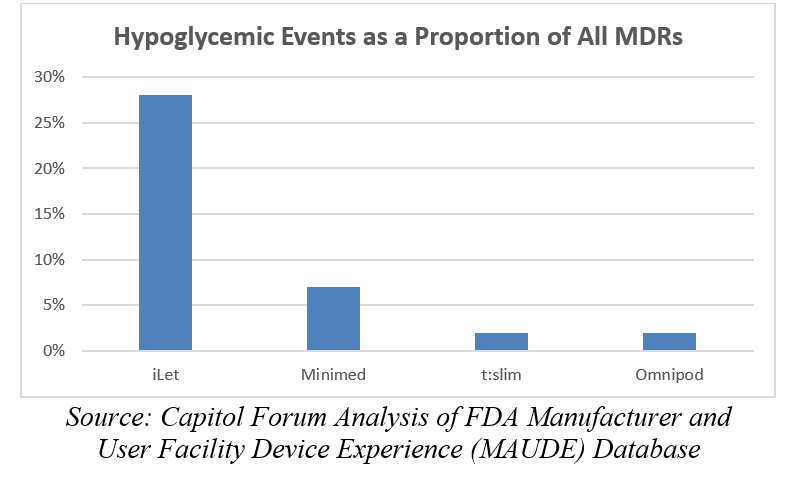
Relative Frequency of Hypoglycemic events exceeds that of competitors. An analysis of medical device reports (MDRs) submitted by Beta Bionics to the FDA suggests that when an iLet device experiences issues, it is more likely to result in a hypoglycemic event than other insulin pumps such as the Medtronic (MDT) Minimed, the Tandem Diabetes (TNDM) t:slim, and the Insulet (PODD) Omnipod.
Since January 1, 2024, of all iLet MDRs submitted to the FDA, 27% listed hypoglycemia as a patient problem, while the Minimed, t:slim, and Omnipod showed hypoglycemia as the patient problem in 7%, 2%, and 2%, respectively, of all MDRs over the same time period.
Source: Capitol Forum Analysis of FDA Manufacturer and
User Facility Device Experience (MAUDE) Database
Data for iLet MDRs, however, may not be complete. According to the June inspection obtained by The Capitol Forum, FDA investigators observed that Beta Bionics was not properly investigating patient complaints and submitting them as MDRs to the agency.
FDA investigators observed that, between July of 2023 and June of 2025, Beta Bionics had received 18,000 complaints from users that “confirmed various malfunctions of the iLet Bionic Pancreas System; however, the complaints show no corrective actions were taken and there is no justification for why corrective actions were not taken, considering the risk to patients from the malfunctions.”
18,000 complaints is a significant number for Beta Bionics, given the relatively low number of iLets in the field. The company’s quarterly filing from the month after the inspection noted that there were a total of 24,085 installed customers; that number may not reflect current active users, as the company says it only tracks patients who started using the iLet device since its launch.
Among the complaints cited as not having been properly handled, the FDA investigators listed “insulin dosing errors” and “hypoglycemic events with confirmed related component failure or supplier manufacturing process.”
The FDA investigators also observed that the company had not been reporting MDRs to the FDA “because the events did not result in death or serious injury of the patients,” even though they could have.
Moreover, the FDA investigators observed a pattern in which the iLet gave unnecessary doses of insulin to patients when they were sleeping, as in the case of Alex, or dosing patients when the device incorrectly logs a meal.
“Patient reported severe hypoglycemic episode resulting in hospitalization, and expressed concern about five consecutive meal announcements logged in the iLet pump, which the user does not recall doing,” one complaint flagged by the investigators noted.
In another complaint the investigators flagged, a mother stated that her child’s iLet logged six meals between 9:30 PM and 12:30 AM and five additional meals between 7 AM and 9 AM, pushing him into a severe hypoglycemia that required hospitalization.
Much like Jill’s experience, FDA investigators observed that Beta Bionics often blamed these malfunctions on user error, despite the relatively hands-off nature of the device. A company investigation into “allegations of hypoglycemia during adaptation phase of initial use of the iLet Bionic Pancreas system” was concluded by finding the root cause to be the user’s “understanding of how to manage their diabetes on the iLet.”
In the wake of the FDA’s inspection, Beta Bionics CEO Sean Saint disclosed to investors that “we were not reporting complaints such as the device screen cracking or a hypo or hypoglycemic event that did not require medical intervention. We now report these types of complaints to the FDA given they could result in an adverse event if ignored.”
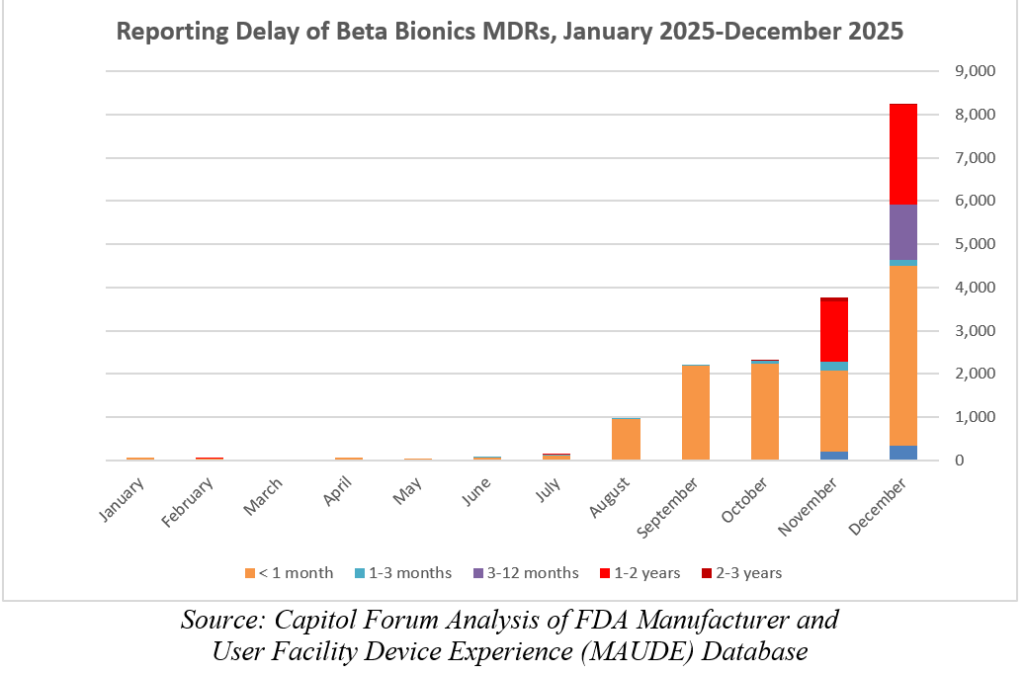
Since then, Betas Bionics has been reporting a large backlog of reports to the FDA, with thousands of reports being over a year old; companies are required to submit an MDR to the FDA within 30 days of learning of a device problem.
Source: Capitol Forum Analysis of FDA Manufacturer and
User Facility Device Experience (MAUDE) Database
Beta Bionics management has told investors that it expects to have completed the remediation of historical reports by the end of the second quarter of 2026.