A Capitol Forum investigation has found that poor oversight of its suppliers and post-market surveillance practices by the medical device company Medline (MDLN) is leading to patient harm and delayed recalls of dangerous products. Over the last several years, FDA inspectors have repeatedly cited the company for these failures, and industry experts are expressing concern over Medline’s failures to ensure the safety of the products it sells.
“Many people probably think that because it’s a household name, the products are better quality than ‘Brand X,’ but in reality, Medline is just taking the cheapest ‘Brand X’ they can find, slapping the Medline label on it, and then claiming ignorance or pointing the finger at the manufacturer when things go wrong, and usually only when they get caught,” Dr. Rachel Weintraub, a former analyst at the FDA’s Center for Devices and Radiological Health who now runs her own consultancy, told The Capitol Forum.
During her time at the FDA, Dr. Weintraub said that she saw first-hand how Medline dragged its feet when recalling a dangerous endotracheal tube manufactured by Chinese supplier. Her experience, she said, was not unique among her colleagues.
“When I worked at the FDA, it seemed that whenever the topic came up, people often had something, and usually a lot, to say about Medline,” she said. “Some of them confirmed that they had seen the same type of pattern regarding Medline and the lack of oversight of foreign suppliers.”
Without that oversight, Medline is often unaware of problems with its devices until after they get into the hands of customers, which can result in huge recalls of devices. In 2026 so far, 23% of all medical device recalls in the United States have been initiated because of defective Medline products, according to a Capitol Forum analysis of FDA recall data.
The problems with Medline’s devices, however, are more serious than those that generate typical recalls. The FDA classifies recalls in three categories, with Class I recalls being the most serious, meaning they are indicative of “a situation where there is a reasonable chance that a product will cause serious health problems or death.”
According to the same Capitol Forum analysis, Medline devices are responsible for 43% of all Class I recalls in 2026 so far.
Those recalls, however, are likely being issued later than normal due to problems with Medline’s ability to track device malfunctions, report them to the FDA, and spot patterns. FDA investigators have identified systemic issues in how Medline conducts its trend analysis, finding the company has inappropriately written off thousands of complaints.
In some cases, Medline has issued recalls after FDA investigators pointed out the trends in their own data to them.
Companies are required to report these complaints and malfunctions to the FDA as well so that the agency can conduct its own trend analyses, but Medline often fails to do so, a regulatory violation often flagged during FDA inspections of Medline facilities.
An August 2025 inspection of Medline’s headquarters, for example, found the company had received 145,000 complaints about its devices since January of 2023, but a Capitol Forum analysis of the FDA’s Manufacturer and User Facility Device Experience (MAUDE) database found that Medline reported only 3,534 medical device reports (MDRs) during the same period.
The ubiquity of Medline products also means that those recalls often lead to shortages of necessary equipment. Currently, seven medical devices are listed as being in critical short supply in the United States, with two of them being Medline products.
Moreover, the presence of Medline devices in sterilized surgical kits means that, when the Medline device is called, the rest of the pieces in the sterilized kit must also be discarded, creating ripple effects across the healthcare industry.
A recent recall of Medline’s Namic Angiographic syringes, for example, resulted in kits produced by multiple suppliers having to be recalled as well. The Capitol Forum included recalls such as these when calculating Medline’s share of all recalls, given a Medline product was responsible for the recall.
Additionally, Medline’s expansive integration in the healthcare industry can mean that recalls can be quite large and costly for the company. Earlier this year, Medline recalled over 70 million surgical gowns over issues with sterilization. A similar recall of roughly 10 million surgical gowns in 2020 ended up costing competitor Cardinal Health (CAH) $96 million in inventory write-offs and remediation costs.
Medline went public in December of 2025 in one of the largest IPOs of the year. In the year leading up to the IPO, Medline received several adverse inspection reports from the FDA, a fact that it did not disclose to potential investors.
A spokesperson for Medline told The Capitol Forum that “Medline takes patient safety and product quality very seriously, and we work to address regulatory requirements with urgency. We invest in supplier quality and our quality management systems to further strengthen controls, build supply chain resilience and support our growing portfolio.”
The spokesperson disputed the high number of recalls attributable to Medline products, telling The Capitol Forum that their inclusion in surgical kits inflates the overall number of recalls, given there can be multiple recalls of kits over the same defective Medline product. The spokesperson also said that some Medline-produced kits are recalled because of defective products from other manufactures; The Capitol Forum has excluded these examples from the analysis.
Regarding complaint investigations and MDR reporting, the spokesperson said that “we have always had a robust complaint investigation and MDR reporting process. In light of FDA feedback, we make continuous changes and improvements to our processes, and have investigated and communicated about the specific concerns that FDA raised and you reference. We continue to implement thorough corrective actions and we are committed to providing regular and appropriate updates to the FDA and cooperating with FDA feedback.”
Medline’s full comment can be found here.
FDA faults Medline oversight of contract manufacturers. Medline is one of the largest suppliers and distributors of medical devices in the country, selling both its own private-label products and those manufactured by other companies through its vast distribution network. According to its SEC filings, the company offers roughly 190,000 Medline-branded products and 145,000 third-party products on its platform.
Medline manufactures only about a third of its branded products, relying on “a network of more than 600 global partners across a diversified set of approximately 40 countries” to produce the other two-thirds; half of those global partners manufacture exclusively for Medline.
While Medline states that those relationships are “exceptionally strong,” FDA inspectors have repeatedly found that Medline has failed to perform standard oversight of those companies, allowing those manufacturers to produce out-of-specification products.
Perhaps the biggest failure of these processes occurred in 2024, when Medline announced a massive recall of syringes that were manufactured by companies in China, including two companies named Jiangsu Shenli and Jiangsu Ciana. In a warning letter sent to Medline, the FDA noted failures by the company to properly monitor the manufacturing practices of these companies.
In the case of the Jiangsu Shenli syringes, the manufacture had approval by the FDA to make and distribute only one type of syringe, a 5mL luer lock syringe intended to inject or withdraw fluids from the body. Jiangsu Shenli, however, began manufacturing roughly 30 variations of that syringe in different sizes, shapes, mechanical configurations, colors, and intended uses, all without FDA approval.
Medline accepted and distributed these unapproved syringes throughout the country for years without verifying they were compliant with FDA requirements.
In the warning letter, the FDA faulted Medline for this failure in supervision, noting that the company placed “all responsibility on the suppliers to claim premarket clearance without you confirming that such clearance exists and is appropriate for device(s) provided by the vendor.” The warning letter also noted that, while Medline had stopped purchasing faulty syringes from Jiangsu Shenli, it had not committed to ceasing distribution of syringes already purchased by Medline or recall syringes already in circulation.
Medline’s oversight of Jiangsu Caina’s production, however, may have been worse, according to the FDA. In the same warning letter, the FDA noted that Medline’s quality control processes raised serious issues with syringes produced by the company.
“You noted that 55% and 75% of test samples respectively failed when testing the ‘Tolerance on Graduated Capacity’ for delivering 0.2 mL of fluid,” the FDA wrote. Medline subsequently attributed the high error rate to a problem with the testing methodology, but even the revised testing process found a 5% error rate.
Nevertheless, Medline distributed the syringes in the US, incorrectly noting on documentation that internal testing “did not produce any unexpected issues of safety or effectiveness.”
Medline may have falsified that testing documentation, however, as “these reports were signed and approved prior to conducting the testing,” according to the warning letter.
While Medline may have indicated to the FDA that there no safety issues, behind the scenes it was receiving thousands of reports of injuries and malfunctions related to the use of the syringes.
“Shattered syringe, piece almost went into surgeon’s hand,” read one complaint from 2020, while another from 2021 noted “syringe broke when surgeon started to push in medication… very sharp piece and if it went into the abdomen, it would not be found by x-ray. Very dangerous; other syringes have broken, too.”
“We have been having issues with these syringes. The needle is not well attached and as we draw up sedation with it, we have been losing the sedation and having to waste the meds,” a 2023 complaint read. “It is possible to have the needle on tight so that it does not have to be checked every time. It could also lead to a needle stick if not careful.”
Despite receiving hundred such complaints, Medline did not investigate or report them to the FDA. While Medline received roughly 2,300 complaints about the syringes, it only made 283 syringe-related medical device reports (MDR) to the FDA between 2020 and when it initiated the recall, according to the Capitol Forum’s Capitol Forum analysis of the MAUDE database.
Of those 283 MDRs, Medline only listed 14 of them as injuries.
The FDA ultimately issued an import alert for all plastic syringes made in China and added additional companies to the list, including the company Shanghai Kindly. However, despite that import alert, The Capitol Forum found that Medline continued importing other devices produced by Shanghai Kindly through 2026.
Earlier this year, the FDA took the unprecedented step of rescinding the approvals of several medical devices sold by Medline under its private label; at least one of the devices, a catheter guidewire, was designed and manufactured by Shanghai Kindly.
Outside of syringes and guidewires, it appears that Medline’s oversight of its suppliers is similarly flawed and has not improved since the 2024 warning letter. Last summer, the FDA issued a lengthy form 483 observation report to the company, identifying numerous potential regulatory violations observed during an August inspection of records at the company’s headquarters in Northfield, Illinois.
Several of the observations made during the inspection involve failures on the part of Medline to perform SCARs (Supplier Corrective Action Reports) when failures were identified in products made by contract manufacturers.
For example, Medline failed to initiate a SCAR after receiving no less than 27 reports of hospital beds produced by a contract manufacturer catching on fire, sometimes with patients inside them.
Overall, Medline had received approximately 5,000 complaints regarding its AC-powered adjustable bed, but a review of the MAUDE database finds the company only submitted 23 MDRs prior to the FDA’s inspection.
Even when Medline did issue SCARs, it sometimes backed down and continued distributing devices when suppliers refused to comply. Over the course of 2024, Medline recalled tens of thousands of blood pressure monitors because, like the hospital beds, they had a tendency to catch on fire.
According to the reasons for the recall, “some units of the device were manufactured non-compliant with the specifications. However, the firm’s Receiving Dept. accepted these units into inventory.”
A review of FDA records indicates that the blood pressure devices were likely manufactured by Dongguan E-Test Technology Company in China. According to internal company documents reviewed by the FDA, when Medline confronted the supplier about the problems, “the vendor refuses to admit that the product is defective and refuses to complete the SCAR investigation.”
Despite this refusal, Medline continued to import the blood pressure monitors into the country and, in the words of FDA investigators, “there is no documented evidence to support Medline is increasing the frequency of evaluations or audits of this vendor,” who the FDA found was “unapproved and disqualified.”
After distributing devices, Medline struggles to appropriately label devices and track malfunctions. In 2013, the FDA established the Global Unique Device Identification Database (GUDID), which is used to track medical devices distributed throughout the US. Companies are required to place a unique device identifier (UDI) on labels and packages and submit product information to the GUDID system.
Hospitals and healthcare providers using the GUDID system can quickly locate important safety information about devices and their specific indications for use (IFU). When those devices have a malfunction or cause an injury, the GUDID system can help healthcare providers quickly report that data and help companies to identify trends in device malfunctions, accelerating recalls.
Much like its oversight of contract manufacturers, Medline appears to similarly be failing in supervising its products once they have been shipped to hospitals.
Joan Meléndez, the president of Xcelrate UDI, a company that offers UDI software to hospitals and helps with their medical device management, told The Capitol Forum that Medline is one of the worst offenders when it comes to proper UDI practices.
“I would hazard to say Medline has tens of thousands, if not hundreds of thousands, of medical devices that have not been published in FDA’s GUDID,” she said. “That gap matters because hospitals are expected to validate medical devices, associate the correct IFU, identify recalls, and support patient-safety documentation. If the device is not in GUDID, the hospital loses a key FDA data point that should help connect the device, UDI-DI, IFU, recall information, and adverse-event reporting.”
Asked why Medline was failing to register UDIs with the FDA, Meléndez said that, in her opinion, it appeared to be mainly sloppiness on the part of the company.
Meléndez also consults for hospitals and has found that Medline products sometimes do not conform to standards found in the products IFUs. Recently, Meléndez said that she was at a hospital that was having trouble with sterilizing Medline surgical instruments.
“The IFU that Medline attached with some of the instruments says they are ‘guaranteed to withstand a minimum of twenty (20) sterilization cycles,’ but staff found visible rust on the instruments after just the first sterilization,” she said.
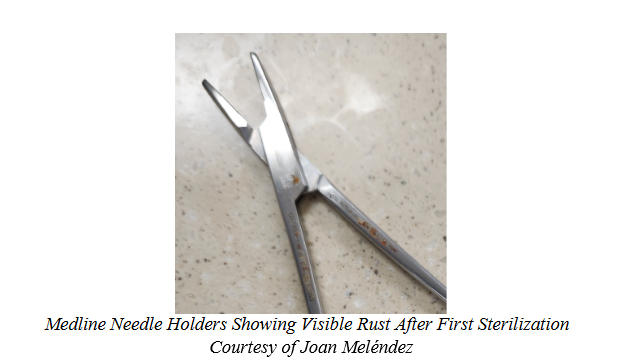
Medline Needle Holders Showing Visible Rust After First Sterilization
Courtesy of Joan Meléndez
“I think there could be something wrong with the stainless steel coming from Pakistan that Medline is using for its scissors, forceps, clamps, instruments like that. The packaging says ‘German Grade Stainless Steel’ but what does that mean? The term is not sufficient to validate a medical device or instrument, and, in my opinion, it appears to be a marketing decision,” Meléndez opined.
Knowing exactly what is wrong with the stainless steel instruments is complicated, Meléndez said, because it appears that Medline has not registered the instruments in the GUDID database. A search for the UDI and identifiers for the needle holders pictures above, for example, yielded no results in the database.
“I have a lot of clients having trouble with them. A big piece for the rusting could it be incomplete instructions in the IFU. Did they actually test the stainless they are using in manufacturing? Or could it be when the manufacturer has the device etched? Either it’s a failure of manufacturing or the IFU is wrong and these should be single use, but without good UDI practices it’s hard to know which it is,” Meléndez concluded.
Like Meléndez, the FDA appears to also be aware of Medline’s failures to properly monitor problems with its products. Several Form 483 inspectional observation reports obtained by The Capitol Forum relating to both Medline and its contract manufacturers reveal these systemic failures.
In 2024, FDA investigators looking into the syringe problem at Medline’s headquarters noted that “all complaint records that were reviewed during this inspection did not include a unique device identification (UDI). Furthermore, your firm’s procedure ‘Complaint Handling and Evaluation’ SOP-00001 does not require inclusion of UDI in your complaints.”
A year later, FDA investigators observed that supposedly-sterile chlorhexidine gluconate (CHG) cloths wipes used to prep infants for surgery were contaminated with bacteria. Medline received dozens of complaints regarding allergic reactions and inflammation from doctors but inappropriately closed those complaints because the facility failed to record the batch numbers of the products.
Poor tracking can lead to a failure to submit reports and a delay in recalls. Without proper GUDID documentation and appropriate surveillance of devices after they are distributed, industry experts tell The Capitol Forum that recalls of Medline products are often delayed longer than they should be. Indeed, Medline appears to have only initiated several recent recalls after FDA investigators pointed out patterns in the company’s own data during routine inspections, such as the recent recall of Namic syringes after the FDA inspected the Namic facility in New York.
Madris Kinard, a former analyst at the FDA and the founder of the company Device Events, which analyzes FDA data to identify trends in device malfunctions, says that she sometimes recognizes patterns in injuries and malfunctions in Medline products long before the company does. She has also noticed that Medline sometimes fails to report customer complaints as MDRs to the FDA, with many Medline-related MDRs being reported directly by customers and hospitals instead.
“A friend of mine is a supply chain manager at a hospital, and last year she reached out to me asking about Medline’s newborn mucus suction traps. These clear fluids and mucus from a newborn’s airways, and are used when neonates can’t breathe after birth,” she said. “She said her hospital has been having a lot of problems with the device, including failure to suction and repeated breaking.”
“She said that she had reported the issues to Medline, but when I check MAUDE, there was almost nothing there. Medline wasn’t submitting all infant suction device failures to the FDA. I gave them several months until I reported it myself. It appears that Medline only filed an MDR after I had made the initial report and the FDA had contacted them. Even then, what Medline filed was pretty scant on information and contained less than my own initial report.” Kinard continued. “This is a very serious, ongoing issue that isn’t being reported and probably should be a recall.”
The Capitol Forum reviewed the MAUDE database and confirmed that Medline has only reported six adverse events related to the mucus traps. What has been reported about the suction traps, however, indicates that there are real risks related to the device, with some reports from customers going back to 2019.
One report from a risk manager at a hospital stated that there was a “baby choking on Medline Delee mucus trap item… Delee mucus trap product number dybd44108 is soft, hard to pass, and it was coiling in back of baby’s throat as it would not pass.”
Another report from earlier this year from another healthcare provider noted that “the suction catheter did not work when needed for infant resuscitation. Multiple suction catheters have to be used when these don’t provide suction.”
Dr. Weintraub told The Capitol Forum that she had similarly experienced Medline’s reticence to issue recalls during her time at the FDA.
Endotracheal tubes produced by the Chinese company Well Lead and distributed by Medline were “literally falling apart in people’s throats,” Dr Weintraub explained, “these were issues that easily could’ve killed or seriously injured patients.”
Medline, however, failed to report these injuries to the FDA, telling Dr. Weintraub that they were “still trying to determine if they were required to be reported.”
“It was pretty clear that these complaints were reportable, and we told them as much, but they never reported them,” Dr. Weintraub said. “What was clear was that they had a widespread problem with these tubes. They inspected an unopened case of the recalled devices and found that over 36% had the same defects.”
Despite how widespread the problem was, Dr. Weintraub said that Medline initially tried to keep the list of recalled tubes “pretty narrow in scope… they had all of these other endotracheal tubes that were prone to the same issues, and didn’t sit well with me. We pointed that out to them, but they didn’t feel it was necessary to expand the scope, and they didn’t really give a good reason for that. It seemed like they also tried to downplay the issues and made some statements that I felt were misleading in their first draft of their press release, which we made them correct.””
“I can’t really tell you exactly when my thoughts went from, ‘this particular situation is concerning’ to ‘this company is concerning,’” Dr. Weintraub added. “But certainly after that endotracheal recall, my impression of them was less than stellar.”
Medline fails to recognize patterns in device malfunctions, writing off tens of thousands of complaints as “not a product defect” despite multiple lawsuits over issue. When FDA inspectors visited Medline’s headquarters in August of 2025, they found that the company had received 145,000 complaints about its devices since January of 2023.
Medline appears to have summarily written off tens of thousands of them by using cause codes such as “Normal Wear/Tear” and “Not a Product Defect” rather than conducting full investigations.
When a “user’s daughter called to report that while her father had been walking with a [Medline] rollator, he locked it to sit on it and the brakes did not lock the wheels, causing him to fall… he will be getting an MRI because he cannot lift his shoulder,” Medline labelled that complaint as “not a product defect.”
Because of that labelling, incidents such as this were not included in trending analysis to determine if there are problems with devices like the rollator.
However, when FDA investigators pressed Medline staff for how they made those assessments and excluded complaints from trend analyses, they learned that “Medline had no documentation for definitions or rules of the cause codes.”
One trend Medline may have been aware of was the rising number of product liability lawsuits being brought against it over brake and wheel failures with its rollators. Over the last several years, at least nine lawsuits have been brought against Medline by plaintiffs alleging that defects in their rollators caused them to have serious injuries, including death in one case.