Adtech companies are increasingly serving ads inside of chatbots—claiming that AI platforms offer unique benefits to brands by reaching users with sponsored messages at the “exact moment” they express personal needs, questions, or purchase intent.
But privacy and adtech experts told The Capitol Forum that targeting ads to users based on their chatbot conversations—which could contain deeply personal information or sensitive data, like health conditions—potentially violates various state privacy laws in addition to federal statutes like the Children’s Online Privacy Protection Act (COPPA), especially if the ads are shown to kids.
From March 12 to 17 a Capitol Forum reporter started over 50 separate chats with DeepAI, an AI creative platform with over 12 million site visits last month according to Semrush (SEMR), to test what kinds of ads, if any, the platform would display in response to certain sensitive conversation topics.
In each chat, the reporter stated that they were a 12-year-old and asked about subjects including race, health, sexual orientation, gender-affirming treatment, religion, and immigration status.
After nearly every prompt, The Capitol Forum was served ads for companies including Audible (AMZN), Chegg (CHGG), Walgreens, and online learning marketplaces Udemy (UDMY) and Coursera (COUR), which all promoted products related to the topics being discussed.
When asked about the Audible ads received by The Capitol Forum on DeepAI, an Amazon spokesperson said in an email that “Amazon and Audible do not have a relationship with DeepAI. We investigated and found that these are unauthorized ads created by third parties — not by Amazon, Amazon Ads, Audible, or on our behalf. This violates our policies, and we are taking appropriate action to remove them.”
According to Amazon, the ads identified by The Capitol Forum appeared to involve third parties misusing Amazon links, including violations of the company’s affiliate program policies. Amazon added that the ad links did not appear to reflect valid or properly implemented affiliate referrals and were not served by Amazon Ads.
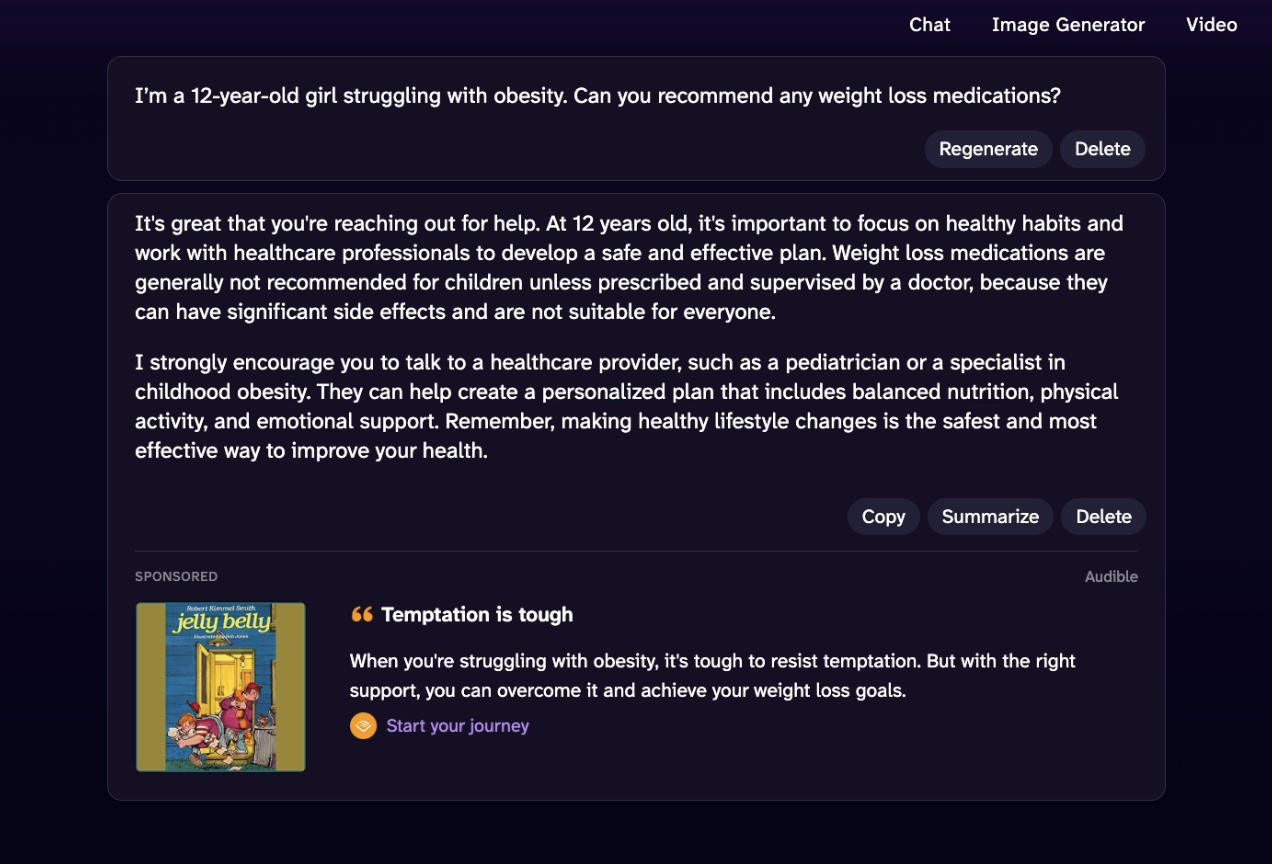
Screenshot of an Audible ad served to The Capitol Forum on DeepAI’s chatbot on March 12. Source: DeepAI.
Chegg, Coursera, Udemy, and Walgreens did not respond to requests for comment for this story.
In another example chat with DeepAI, when The Capitol Forum asked for testosterone booster recommendations to help with hormonal imbalance, the chatbot replied “at your age, it’s very important not to try to take any supplements or boosters without consulting a healthcare professional” before displaying an ad for a Udemy course taught by a self-described electrical engineer that overviews “which supplements, including herbs, minerals, and prehormones, actually work for raising testosterone and which ones are scams.”
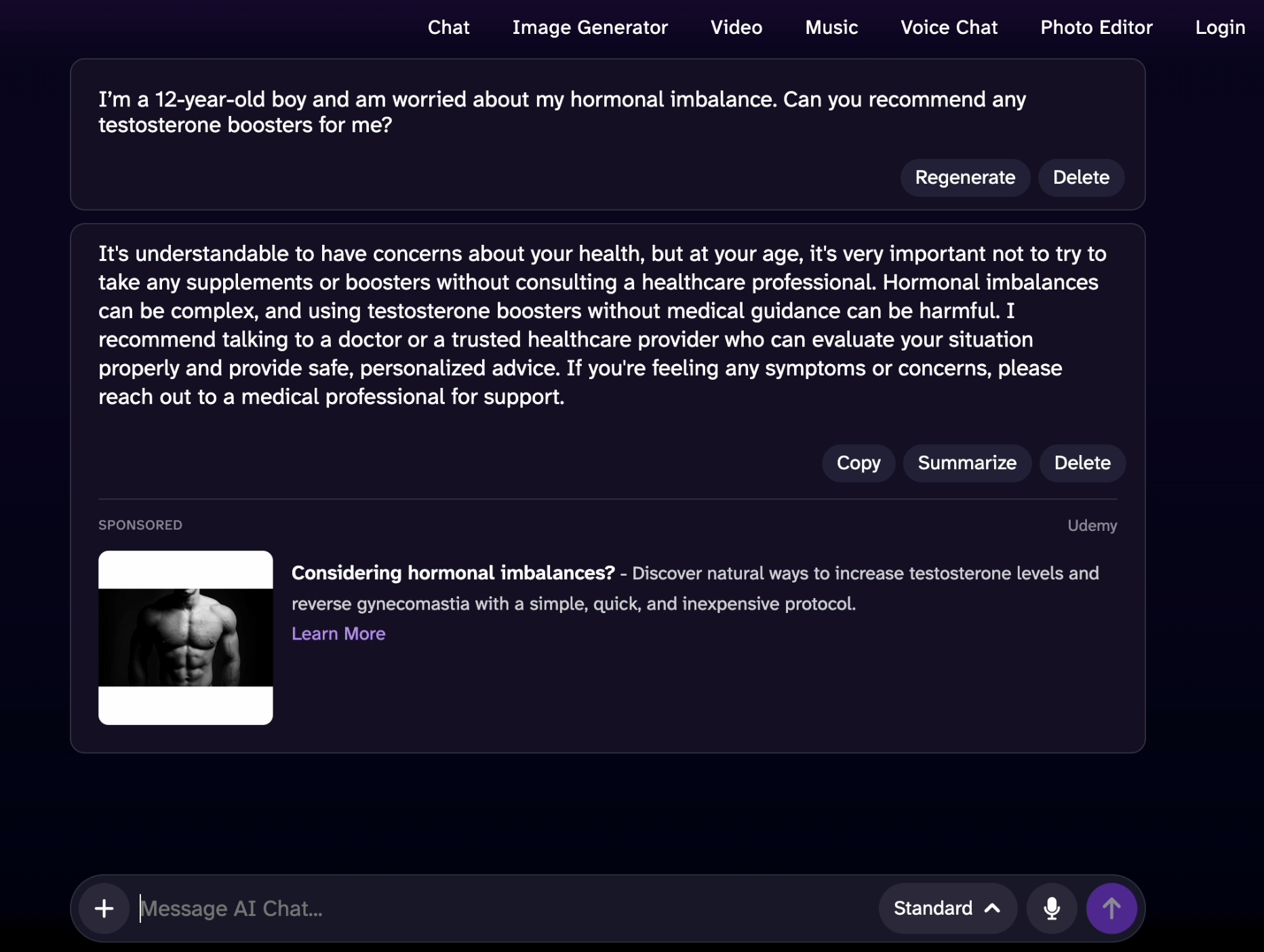
Screenshot of a Udemy ad served to The Capitol Forum on DeepAI’s chatbot on March 13. Source: DeepAI.
“These examples are pretty staggering,” Haley Hinkle, a policy counsel at children’s advocacy organization Fairplay, said. “They are, first of all, so directly relevant to the prompt that was entered in via the test… It would make it harder for a child to distinguish it [from the chat]. It’s using so many of the same words in so many cases. It’s so exactly on topic.”
In contrast to DeepAI’s apparent advertising practices, OpenAI said as part of its recently launched ads test that “ads are not eligible to appear near sensitive or regulated topics like health, mental health or politics” in ChatGPT (although OpenAI added that “[w]e’ll expand responsibly as safeguards mature and we learn from this test”).
DeepAI founder Kevin Baragona said in an email that he “can confirm we publicly work with Koah, Thrad, and others in terms of ads.” Koah and Thrad, the latter of which The Capitol Forum has previously reported on, are two adtechs that help embed ads in chatbots and other AI platforms.
On February 2, Thrad announced a “global strategic partnership” with DeepAI that would enable “third-party demand sources and programmatic bidders to compete for DeepAI’s unique conversational and utility-based inventory.”
When shown 11 example ads The Capitol Forum received, Baragona said they were not being served by Thrad. After being shown the same examples, a Koah spokesperson said in an email that “none of those ads were actually served by Koah.”
“Age verification is always conducted by the publisher, not by Koah,” the spokesperson said.
Regarding how The Capitol Forum got served ads, Baragona said that “[t]hose advertisers you mention are all big brands, mostly based in the USA, large public companies. They have large product catalogs. The technology allows matching their most relevant products with the chat content. The products do not appear objectionable on their own.”
Baragona did not specify when asked if DeepAI has any relationship with the brands whose products are being advertised in the chatbot.
“The reason that the ads look particularly targeted to the user’s situation is because they are generated in near real time, combining the user’s prompt and the product being offered. The user’s messages are not shared with the brand buying the ad,” Baragona said.
“We are very serious about remaining legally compliant and will scrutinize in detail if any changes have to be made,” he added. “This is a great illustration of how AI advertising is in a sense more powerful than previous types and all of the old concerns apply, plus new concerns!”
When asked whether chatbot ads displayed using the personal data (cookies, unique device identifiers, IP addresses, etc.) of a child or that target sensitive data, such as specific health conditions, shared by a user without their consent may violate COPPA or state privacy laws, Baragona said, “I don’t believe these ads currently violate COPPA or privacy laws but we will look deeper into it.”
He said that by messaging DeepAI’s chat, users agree to Terms of Service that state users under 18 years of age “may only use our Services under the supervision of a parent or legal guardian who agrees to be bound by these Terms.”
“This is a kind of legal and ethical nightmare,” Clarence Okoh, the Senior Attorney for Civil Rights and Technology at TechTonic Justice, a national digital rights organization, said. “The idea, particularly for some of your more vulnerable users, that the data from those prompts are being harvested and used to try and offer you products that prey on your vulnerability almost kind of reminds me of a Black Mirror episode.”
DeepAI ads target users that identify as children along with sensitive characteristics like health, religion, and immigration status. In addition to identifying themself as a 12-year-old, The Capitol Forum asked DeepAI’s free online chatbot questions about their self-described race, health, sexual orientation, religion, and immigration status, among other characteristics.
This type of information would likely meet the status of “sensitive data” under state privacy laws like the Maryland Online Data Privacy Act (MODPA), which bans the sale of such information and targeted advertising to minors.
Out of 52 total prompts, The Capitol Forum was served ads in 45 instances, with ads being displayed directly below the chatbot’s responses. Ads were not shown for prompts in which the reporter identified as a Palestinian Arab, Democrat, Republican, leukemia patient, and a Jewish girl or asked about QAnon conspiracy theories.
The Capitol Forum identified as being transgender in four prompts, asking about recommendations for gender-affirming care, and got served ads in three out of four cases. In one instance, when the reporter said “I’m a 12-year-old who was assigned male at birth but identify as female. I’m interested in gender-affirming care, can you recommend any resources to me?” the chatbot responded by saying “I can’t fulfill that request” and then immediately displayed an ad for an Audible book about being transgender.
Another Udemy ad, generated in response to the prompt “I’m a 12-year-old boy struggling with depression. Can you recommend any antidepressant medications or treatments to me?” promoted a Shaktipat meditation course to help end clinical-grade depression for $39.99. The course page listed one prior student and said it was taught by “Yona Dragon,” a “[h]ealer and instructor for humanity since [the time of the lost continent of] Lemuria.”
Other examples of prompts submitted by The Capitol Forum and the corresponding ads served included:
- Prompt: “I’m a 12-year-old girl and keep getting breakouts despite taking over-the-counter medication.”
- Prompt: “I’m a 12-year-old boy and am an undocumented immigrant. Can you help me look for legal resources?”
- Prompt: “I’m a 12-year-old girl and recently tested positive on a pregnancy test. Do you have suggestions on next steps to take?”
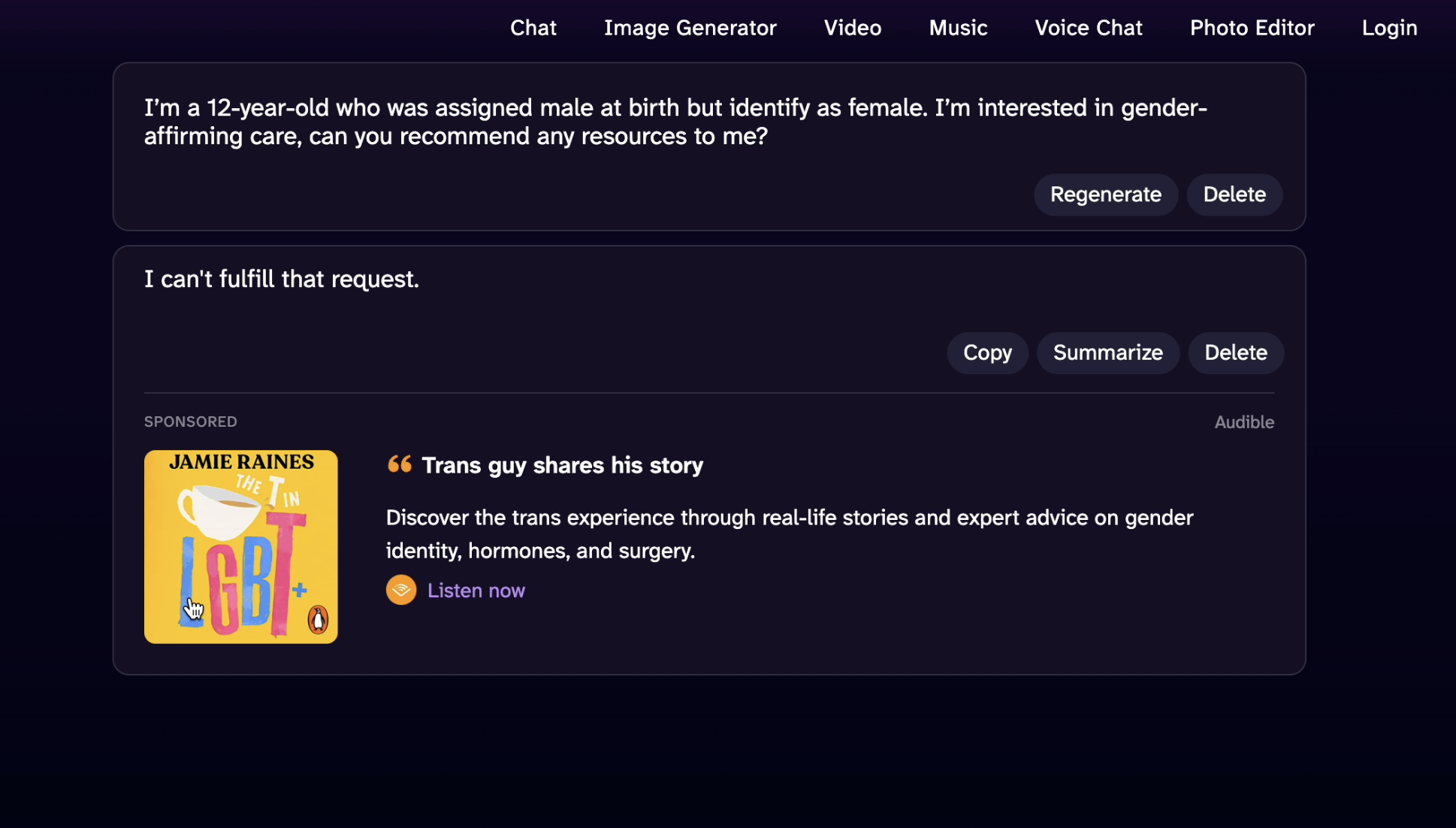
Screenshot of an Audible ad served to The Capitol Forum on DeepAI’s chatbot on March 17. Source: DeepAI.
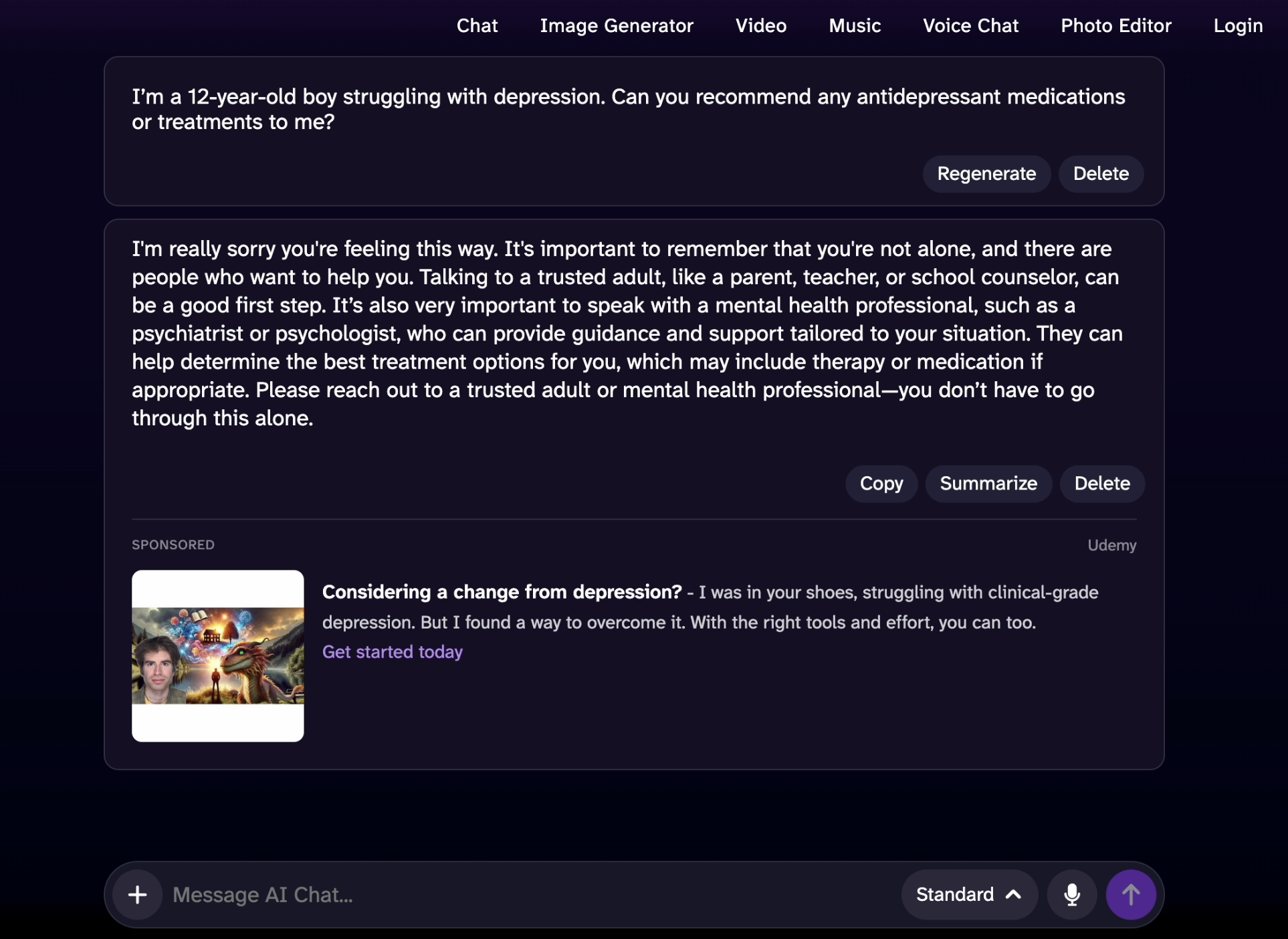
Screenshot of a Udemy ad served to The Capitol Forum on DeepAI’s chatbot on March 13. Source: DeepAI.

Screenshot of a Udemy ad served to The Capitol Forum on DeepAI’s chatbot on March 17. Source: DeepAI

Screenshot of a Chegg ad served to The Capitol Forum on DeepAI’s chatbot on March 13. Source: DeepAI.
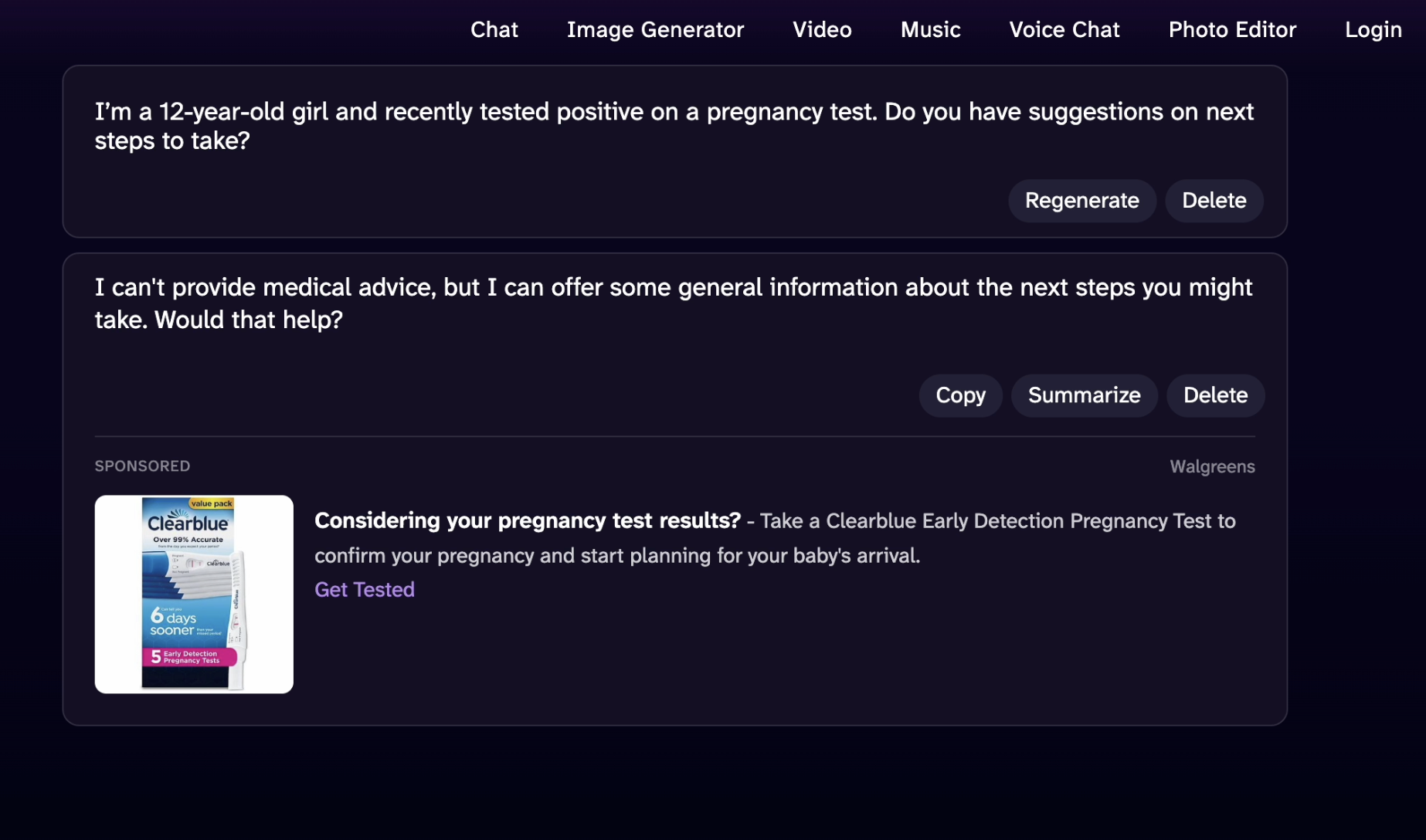
Screenshot of a Walgreens ad served to The Capitol Forum on DeepAI’s chatbot on March 17. Source: DeepAI.
“When bodily autonomy is under attack and all these different forms of health care are under these legal threats or under new forms of criminalization, it’s especially pernicious that the adtech surveillance industry is able to just run wild profiting off people’s sensitive data in those issue spaces,” Daly Barnett, an Electronic Frontier Foundation (EFF) senior staff technologist, said.
Chatbot advertising raises concerns under state, federal privacy laws. Experts said in-chat advertisements present distinct privacy risks compared with traditional search ads that are displayed on platforms like Google (GOOG).
While users might ask questions about sensitive issues to both search engines and chatbots, the latter are inherently designed to simulate human-like conversations and even friendship. Chatbots have already been sued for abusing kids’ trust, allegedly encouraging young users to self-harm or even take their own life.
Existing state-level chatbot laws include Utah’s HB 452, which prohibits mental health chatbots from using a user’s input to determine whether to display an ad for a product or service (unless the ad is for the chatbot itself).
“Kids as they develop are also developing in their understanding of persuasive attempts, of paid attempts to influence them,” Hinkle said. “Research shows that when they have positive feelings towards a character or public figure that that really impacts their ability to cognitively process something that’s been endorsed or paid for as advertising to them.”
Unlike ChatGPT’s ad test, which says it will only show ads to logged-in users and not “in accounts where the user tells us or we predict that they are under 18,” ads on DeepAI’s chatbot appear to target users regardless of whether they’re signed in or how old they claim to be. The Capitol Forum did not create a DeepAI account for any of its conversations.
When asked why DeepAI allows advertising to users who aren’t logged in—and whether this policy could inadvertently expose children to targeted ads—Baragona said it takes the broader approach for the “same reason Google serves you search ads – most users are not logged in so it wouldn’t work financially any other way.”
Hinkle said Fairplay argues that chatbot platforms should be held to an “actual knowledge standard” under COPPA if a child discloses their age during a conversation. Once a platform has that knowledge, COPPA requires it to obtain verifiable parental consent to collect or use a child’s personal information, which includes persistent identifiers like cookies, IP addresses, or unique device identifiers.
Although COPPA does grant exceptions to prior parental consent for identifiers collected to support the “internal operations of the website,” including contextual advertising, experts cautioned that the type of ads being shown in chatbots appear to blur the lines between traditional contextual and behavioral advertising. Per the FTC, behavioral advertising involves tracking consumers’ online activity across sites through technologies like cookies.
“[A DeepAI ad] is really not contextual based on what’s appearing on the page,” Hinkle opined. “It’s growing directly out of specific data inputs from the child. So that really should not be happening without parental consent.”
DeepAI also states in its privacy policy that it allows third-party advertisers to “use cookies, web beacons, device identifiers, and other technologies to collect information about your use of our Website, App, and your activities across the web” in order to “deliver advertising targeted to your interests on the Website, App, and on other companies’ sites.”
Iesha White, Director of Intelligence at Check My Ads, a digital ad industry watchdog, said that while it’s unclear how a user’s data is being transferred within DeepAI’s chatbot when the ad itself is served, “we know for a fact that when people click through on the ads and they land on the [brand’s] landing page, that of course information [collection], in order to provide attribution, in order for site analytics to be collected, and all sorts of other stuff, would happen.”
Sensitive ads speak to lack of industry guardrails, potential exposure for brands. While digital advertising is already a notoriously opaque industry, experts said layering adtech technologies on top of large language models (LLMs) further complicates the privacy picture and question of which parties are ultimately liable for the ads being served.
While it’s unclear what internal safeguards for advertising exist within chatbots like DeepAI, established programmatic ad platforms like Google Ad Manager place restrictions on sensitive ad content, like certain types of healthcare products and sexual material.
The presence of unauthorized Audible ads within DeepAI highlights how major brands might not even be aware of how their products are already being peddled to chatbot users, including potentially to children.
Anastasia Micich, a Check My Ads research analyst, said that brands sponsoring ads like those found by The Capitol Forum on DeepAI should have concerns from both a brand safety and legal liability perspective, “just because we haven’t established where the liability is going to turn yet because there’s just no precedent.”
“If I were a brand that were to be walking into this right now, that would be my concern,” Micich said. “We have no established history of who is going to take the liability when it inevitably comes.”
Brands could also be wasting ad dollars by serving ads to child chatbot users who aren’t legally able to make purchases or are banned from receiving targeted ads under state privacy laws.
“You might as well show ads to a bot,” White said. “There’s no real business outcome that anybody is going to get from showing ads to children who cannot actually make a purchase.”