Published on Jun 13, 2026
By John H. Pendleton
The biggest names in technology seemingly have made nuclear power central to meeting their voracious energy appetites. Microsoft, Google, Amazon, and Meta have announced agreements, funded startups, and signed power purchase commitments they claim will power the AI revolution with carbon-free, nuclear-generated electricity. While this story sounds promising, the numbers underpinning it deserve scrutiny, for the reality of a hyperscaler-driven nuclear energy resurgence is far from assured. New nuclear technologies will first have to be proven to work, safe to operate, and cost competitive and scalable.
Demand estimates vary widely, but a reasonable midpoint of independent analyses suggests that data center electricity demand could exceed 550 terawatt-hours per year by 2035. In contrast, taken together and if fully realized, all the announced hyperscaler nuclear deals could supply about 13 gigawatts—which translates to just over 100 terawatt-hours added to the grid annually—by the mid-2030s. That is substantial but less than 20 percent of what AI will need.
Why are the hyperscalers not aiming for greater reliance on nuclear to meet this growing need? The answer is both timing and priorities. The big technology and chips companies are rushing to build data centers and infrastructure to compete in the AI race now. This requires intense focus and massive capital expenditures. However, new nuclear construction requires a decade-plus to build. It can’t match the pacing of data center energy demand.
The practical consequence is that the electricity generation gap will continue to be filled by renewables and natural gas. Solar and gas are relatively cheap, quick to permit, and available at scale — making them the rational choice when a data center needs power in three years. A small, modular nuclear reactor needs a decade or more. To date, and despite major efforts by dozens of nuclear developers, many of them startups, there are no such reactors in the United States that are fully licensed, let alone have an established operating history and supply chain that could enable rapid deployment. Therefore, the nuclear energy commitments function less as a near-term supply strategy than as a long-range aspiration and, in the interim, a hedge that allows the companies to take advantage of nuclear’s reputation as a climate-friendly energy source.
Nuclear electricity generation also has some peculiar risks that must be reckoned with. Fuel supply is the first: several of the reactor designs will utilize high-assay low-enriched uranium, which will be more efficient than standard uranium fuel. However, this new fuel does not yet exist at commercial scale domestically. Second, more reactors mean more spent fuel, and the United States still has no permanent repository for highly radioactive material. Without a politically durable plan for spent fuel, the most likely outcome is long-term storage at reactor sites, which may raise social and environmental concerns. The third is reputational risks — a cost overrun, safety event, or siting dispute at a hyperscaler-backed project could set back both nuclear development and the broader clean energy commitments attached to it. Communities near proposed data centers are already pushing back — against noise, energy and water consumption, grid impacts, and the dizzying pace of development. Recent surveys are showing a public increasingly concerned about rising power bills and who are directly blaming AI data centers for that rise.
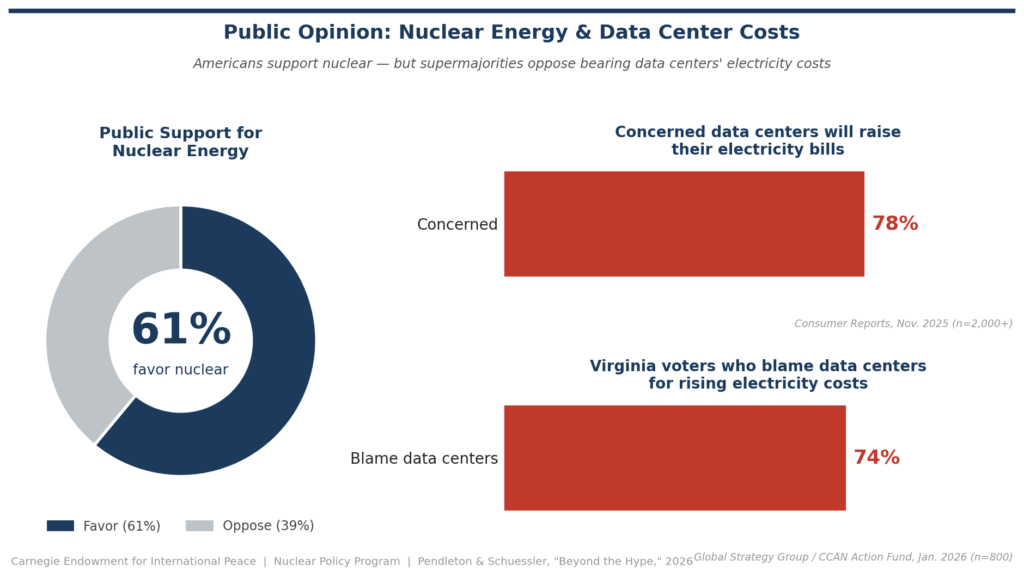
Paradoxically, nuclear has a broad and growing support base in the United States. Public favorability for nuclear power is at its highest level in years. Polling consistently shows majority backing for existing plants and growing openness to new construction, particularly when framed around energy security and climate. (However, broad support for nuclear may not translate to support for a new nuclear plant being built nearby to enable AI.) Nuclear support is also bipartisan, which is vanishingly rare these days. Public and political support for nuclear—and the scale of AI-driven electricity demand—has therefore created a policy window for nuclear that did not exist five years ago.
At the federal level, securing a domestic supply chain for the specialized uranium fuel needed for the new reactor designs and establishing a credible path for nuclear waste are prerequisites for a nuclear expansion. Congress and the Department of Energy have tools available and have been taking steps to support nuclear including expanding loan guarantees for several reactor projects and even investing directly in Westinghouse, which builds large-scale reactors. Such federal efforts would need to be sustained in both future Administrations and Congresses over decades.
At the state level, governors and legislatures are already revisiting siting statutes, updating interconnection rules, and recruiting advanced reactor developers. Several have modified frameworks to accommodate new reactor designs. Cost worries will likely prove to be the biggest stumbling block. The billions in overruns and years of delays at Plant Vogtle in Georgia are fresh in the collective memory and few state politicians will want to saddle ratepayers with electricity cost increases needed to underwrite big nuclear projects. Yet, if big tech companies don’t step up with big commitments to nuclear energy, it is difficult to see where else the funding would originate.
If states are where the action will be, the most important institutional gap is at the public utility commission level. Many of these commissions are thinly staffed and inherently political and are being asked to evaluate load forecasts and approve integrated resource plans without standardized tools. Commissions also lack common frameworks for evaluating fuel supply risk, spent fuel storage obligations, or small modular reactor schedule uncertainty — all critical to planning and approving energy plans for the state.
Make no mistake: the capital, the policy attention, and the commercial interest in advanced nuclear are converging in ways that have not previously aligned. Splashy announcements from the hyperscalers have created excitement but they are not yet underwriting a nuclear renaissance. Translating that convergence and excitement into durable outcomes means treating the hype and the reality as separate — and building the analytical infrastructure, at every level of government, to close the distance between them.
Because getting nuclear right is more important than getting it fast.
John Pendleton is a visiting scholar at the Carnegie Endowment for International Peace where he focuses on nuclear energy and technology resilience issues. Prior to joining Carnegie, he served almost thirty-five years at the U.S. Government Accountability Office.

