Published on Jul 11, 2026
By Seth Frotman & Ben Kaufman
In 2019, while the first Trump administration was busy with record-setting handouts to billionaires, Washington state took bold action to make its economy more progressive. Among a variety of actions, the state imposed a 1.2 percent surcharge on the in-state incomes of banks with more than $1 billion in yearly profit. In just the first three months of 2020, when this big bank tax went into effect, that provision raised $34 million in new revenue that Washington could spend on “schools and essential services.”
What happened next provides a clear lesson in why court reform has to be at the center of every policy conversation—and in how a 90-year-old tax law may hold the key to fixing our economy and our democracy.
As is now inevitable for any ambitious progressive economic agenda, the Washington big bank tax quickly came under fire from well-heeled, right-wing ideological opponents. Before the new tax even went live, industry groups sprinted to the courts and demanded a declaration that the law was unconstitutional.
Conservative litigants usually bring these kinds of cases in federal court, where actual jurisprudence has too often been replaced with pro-corporate Calvinball. We have documented how industry advocates have mastered the art of engineering standing before favorable judges (especially in Texas), then quickly securing desired relief based on threadbare allegations of purported harm on the most dubious of legal theories.
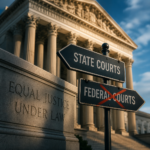
But the story of the Washington tax has a different ending. That provision was not immediately dragged into federal court because of a 1937 law called the Tax Injunction Act (TIA). That law says that lower federal courts can’t “enjoin, suspend or restrain” a state tax if “a plain, speedy and efficient remedy may be had in the courts of such State.” So the case remained in the Washington state court system, where the tax actually got a fair shake. The Washington Supreme Court ultimately saw through the challengers’ cynical arguments, ruling unanimously that the tax was valid, and the federal Supreme Court declined to review their decision.
The lesson here is clear. Washington’s tax didn’t survive just because of good luck or clever lawyering. This ambitious effort to ensure fairness for Washington’s residents benefited from what is sometimes known as “jurisdiction stripping.” Congress determined 89 years ago that in this realm of economic policymaking, principles of separation of powers and federalism dictate an extremely limited role for federal courts. The sky has not fallen as a result of that determination. Jamie Dimon is still rich, while kids in Washington’s schools have a better shot at life.
Washington’s big bank tax is just one example of an important recent trend of states experimenting with new progressive levies against a backdrop of federal retrenchment. States have already passed new taxes on capital gains, millionaires, gambling sites, Big Tech’s targeted ads, and more. In each instance, the TIA and its approach of tailoring the appropriate role of the federal judiciary have been central to the efforts to protect these democratically enacted reforms.
Tax policy is also far from the only topic where Congress has limited the role of the federal courts or otherwise tailored their reach. In fact, Congress has done exactly that in a variety of non-tax policy areas. This is a practice with a lengthy historical pedigree.
To end the chicanery we have seen from federal courts that are ideologically and inappropriately inserting themselves into matters of economic policymaking, Congress should reassert its role in determining the appropriate role of the judiciary. Specifically, Congress should limit federal courts’ involvement in economic policy, as well as prevent K-Street special interests from shopping for handpicked judges that bend the law to rule in their favor. Everything has to be on the table. To prevent venue shopping, Congress could randomly assign cases across Circuits or create a new federal Circuit specifically for administrative law challenges. (Congress did something similar in the 1980s, channeling monetary claims and certain intellectual property claims to the newly created Federal Circuit.) Congress could also change the standard for judicial review by fundamentally rewriting the Administrative Procedure Act, or, if necessary, even stripping federal review entirely in certain areas. If a future administration wishes to accomplish anything on economic justice, these changes need to be front-of-mind, both as a standalone package and as a key part of individual bills in specific policy areas.
Some will probably question whether pushing for court reform is worth the effort given that the courts themselves are likely to undermine it. Skepticism around the Roberts Court’s willingness to give up the power it has dubiously aggrandized is obviously warranted. But compliance-in-advance is rarely a good strategy, and there are reasons to believe that courts would respect clear directives from the legislative branch (that is, if John Roberts can be expected to abide by his own writing). Courts have consistently read the TIA’s core jurisdiction-stripping provisions to apply broadly, including to prevent other important federal laws from acting as a backdoor to undermine the TIA. Even the arch-conservative federal judge J. Campbell Barker recently refused to sign off on a highly questionable settlement between the IRS and a religious group regarding participation in political campaigns because of the TIA’s analog for federal taxes—the Tax Anti-Injunction Act.
It’s time for those who stand with working families to realize that their policy ambitions must be paired with court reform. The good news is that Congress has the tools to decide the appropriate role of the federal judiciary across a range of policy matters. It’s time to end the destructive and antidemocratic aggrandizement of our unelected judiciary—its endless vetoing of basic economic policymaking at the behest of the rich and powerful. Congress can rediscover its historic role in defining the scope of judicial review.
Seth Frotman was general counsel of the Consumer Financial Protection Bureau from 2021 to 2025. He is a senior fellow at the Columbia Law School Center for Law and the Economy and the University of California Berkeley Center for Consumer Law and Economic Justice.
Ben Kaufman is a Senior Fellow at Protect Borrowers and previously worked at the Consumer Financial Protection Bureau.

