Published on Aug 08, 2026
By Evan Swarztrauber
Imagine a world without two-day shipping from Amazon. Or one where Google Maps doesn’t work and the Apple App Store is overrun with malware.
You shouldn’t have to. These far-fetched scenarios wouldn’t normally be taken seriously in a policy debate about competition legislation.
But one of the perks of Big Tech’s limitless coffers is the resources to spread prophecies of doom anytime those coffers are threatened. And we are seeing that dynamic, yet again, with tech antitrust bills before Congress.
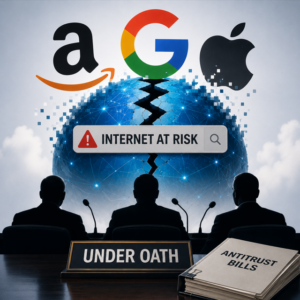
Recently, Senators Chuck Grassley (R-IA) and Amy Klobuchar (D-MN) reintroduced the bipartisan American Innovation and Choice Online Act (AICOA), which would bar the largest players, like Amazon, Google, and Apple, from unfairly favoring their own services and stifling competition on their platforms. It follows the reintroduction of the Open App Markets Act (OAMA), which would enable competitive app stores and allow developers to use their own billing systems.
These bills should be noncontroversial. In a landmark investigation years ago, Congress found dominant platforms harmed consumer choice, innovation, entrepreneurship, and digital privacy. Federal antitrust enforcers have active suits against Apple and Amazon for monopolization and won two cases against Google. Global enforcers across continents have reached similar conclusions.
The evidence is overwhelming, and Congress responding to the facts should hardly be cause for alarm. But any member of Congress weighing these bills will face an onslaught from tech interests warning that voting yes means breaking Amazon Basics, disabling Apple’s Find My iPhone tool, or stopping Google Maps from appearing in Google search results.
It’s a familiar playbook. Policymakers have identified exclusionary and anti-competitive practices, crafted bills to alleviate them, and then been accused of nuking beloved products or “breaking” the Internet. The monopolists don’t explain why discriminatory practices are actually necessary. Rather, they forecast catastrophe and dare politicians to take the risk.
Microsoft issued similar warnings when the government, in 1998, challenged its tying of Internet Explorer and Windows. Microsoft, the target, is worth some $3.5 trillion today and Windows remains ubiquitous. Ironically, the companies now echoing Microsoft’s arguments were among the beneficiaries of the case.
So what do these bills actually do? AICOA bars firms from discriminatory self-preferencing, tying services, and misusing the business data of companies dependent on their platforms to unfairly compete against them. But the prohibitions are not automatic, and not every instance of self-preferencing would be banned. For the bill’s core provisions, the government would have to prove in federal court that such conduct materially harms competition. If recent antitrust jurisprudence is any indication, that’s not an easy bar to clear. Critically, AICOA and OAMA have affirmative defenses for covered companies and exemptions for conduct needed for privacy and security.
Amazon could still sell its own batteries. It just couldn’t use confidential sales data to copy successful products and then manipulate the platform to benefit its own versions. Google wouldn’t have to stop showing its own results in Maps. It just couldn’t discriminate against other local-search services. Yes, Apple couldn’t require every app and transaction to go through its store, but it could still remove malware and fraud—just as it does on Macs, where consumers can choose how and where to download and pay for apps.
While Big Tech’s dramatic predictions are hypothetical, the problems with the status quo are well documented. Internal company documents unsealed in California’s antitrust case appear to show Amazon leveraging its market power to pressure vendors into getting rival retailers to raise their prices or remove discounted products—so Amazon would not have to match the lower prices.
Apple skims up to a 30% cut of app developers’ sales, roughly 10 times the typical credit card processing fee, inflating the cost of digital services around the world. Google has been ruled a monopolist in search, advertising technology, and Android app distribution—with courts finding its conduct raised advertising prices, harmed publishers, restricted customer choice, and entrenched its dominance.
No one needs to warn about those outcomes. They happened, they’re happening, and they will continue to happen if Congress fails to act on its findings.
No senator wants to be responsible for ushering in a tech apocalypse of popular services. About 200 million Americans use Prime, and Amazon brought in nearly $50 billion in subscription-services revenue last year. More than 150 million Americans use Google Maps every month. Apple’s services segment generated over $80 billion in gross profit in 2025, with the App Store as its largest engine.
Given how lucrative these services are, it’s not plausible that these companies would shut down or materially degrade them if laws like AICOA and OAMA simply said they can’t leverage their dominance against competitors. Intervening in tech markets isn’t costless, but abandoning or severely degrading these services is far less likely than simply modifying them to comply.
A hostage negotiation rests on the credibility of the threat, and Big Tech’s claims shouldn’t be taken at face value.
Senators themselves are in the best position to bring clarity to this debate. They can demand that Amazon, Apple, and Google identify exactly which provisions would force them to degrade or shutter services, and why the bill’s affirmative defenses for legitimate and pro-competitive business practices are inadequate.
If the threat of these bills is so profound, it is past time that the CEOs of these firms be asked to back up their doomsaying under oath. Will the CEOs of Amazon, Apple, and Google commit to ending two-day shipping, letting malware run amok on the App Store, or breaking Maps if the bills pass? Members of Congress, and Wall Street, should like to know.
Until then, our representatives should operate on the facts they have. And those facts favor passing these bills.
Evan Swarztrauber is a senior fellow at the Digital Progress institute and former policy advisor at the Federal Communications Commission.

