Published on Aug 08, 2026
By Hudson Munoz
Anticompetitive practices often drive economic harm, but rarely physical harm. That’s exactly what is happening when it comes to America’s gun industry.
I spent the last two years investigating the economics of gun sales, and the results were staggering: Six of America’s largest gun manufacturers, controlling 66% of the domestic wholesale handgun market, have policies that effectively set a minimum price at which distributors and retailers can sell guns.
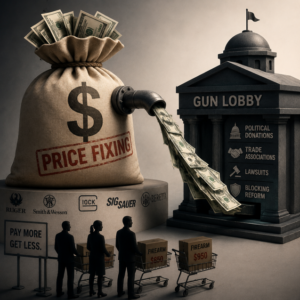
At the behest of retailers, these manufacturers punish those who sell for less and capture profits that price competition would otherwise return to consumers. Inflated profits fund the trade associations, political action committees, and Second Amendment litigation that have stopped nearly every serious gun safety reform for decades.
The relevant conduct is resale price maintenance: a manufacturer dictating the minimum price at which goods may be sold. Retailers who undercut that price risk losing the right to sell that manufacturer’s products. These policies insulate the entire supply chain from competition. That might seem counterintuitive, since on paper they’re manufacturer-imposed rules — but evidence shows big retailers leverage manufacturers against mom-and pop competitors to protect supracompetitive profit margins.
Because of the potential to harm consumers, resale price maintenance was considered per se illegal under federal antitrust law for nearly a century. In 2007, a 5-4 Supreme Court ended that rule in Leegin Creative Leather Products v. PSKS, instead requiring courts to weigh each policy under a so-called “rule of reason.” Under Leegin, courts balance likely anticompetitive effects against beneficial business justifications, at least in theory.
In practice, the rule of reason nearly always disposes of antitrust cases before balancing happens. As one law review article put it, given that “balancing is at the heart of the rule of reason, it is quite surprising to discover that courts almost never do any actual balancing of harms and benefits.” A study of 222 federal “rule of reason” cases between 1999 and 2009 found that defendants won all but one, and courts reached the balancing stage in only 2 percent of cases. Between 2009 and 2021, only one case out of 180 got that far. Congress considered legislation to restore the old rule but let it stall.
Industries that fear antitrust enforcement hide their price coordination; the gun industry says it out loud. On a 2014 earnings call, Sturm Ruger’s then-CEO Michael Fifer described “maintaining absolute price discipline, both in the price charged to independent wholesalers and in unilaterally setting the minimum price they can in turn charge retailers.” Distributors, he said, “enjoy better than average margins” in exchange. Fifer’s successor called it a “two-way street”: compliance from retailers and in return for not “devalu[ing] their inventory” (a euphemism for lowering prices to what a free market would demand). When Sturm Ruger did lower prices on two pistol lines in 2023, it paid distributors to make them whole for the difference.
This mutual expectation is what precludes gun manufacturers from invoking United States v. Colgate & Co., which protects a manufacturer’s right to unilaterally announce a price and refuse to deal with retailers who undercut it. Margin guarantees and make-whole payments are not a manufacturer walking away from noncompliant retailers — they’re bargained for consideration, resulting in the sort of collusive pricing agreement the Sherman Act was written to restrain.
Sturm Ruger may be the bluntest voice on this, but not the only one. A former Smith & Wesson sales VP testified under oath that the company disciplined retailers that broke pricing protocols. Glock, FN America, and SIG Sauer maintain price policies backed by escalating penalties ending in cutoff of supply. On its website, Beretta tells distributors to sell at or above “certain specified prices.”
Leegin rested on a theory: guaranteed margins give dealers extra money to spend on services that benefit consumers, like knowledgeable staff. In the gun business, that theory fails twice over. A Shooting Industry report shows retail margins have held flat at about 15 to 20 percent while costs climbed; wages in sporting goods retail alone rose 27.5 percent between 2019 and 2023. That wage growth was the price of keeping the same clerk behind the same counter, not an investment in expertise. Rent and payroll eat the margin before it can fund any service, and dealers themselves describe minimum advertised price guns as near loss leaders subsidized by ranges and classes.
Gun consumers don’t want the imaginary services, anyway. Consumer survey data shows that almost 70 percent of prospective gun buyers say price drives their purchase, versus 13 percent who value knowledgeable staff. (On the price front: A 2014 University of Chicago study found that Leegin drove prices up a median of over 5 percent on affected products.) Even Leegin’s free-riding problem can’t arise here — federal law routes every online gun sale through a licensed dealer and a transfer fee, so no one can browse in stores then capture an online discount.
This pricing harms two groups that agree on almost nothing else: gun owners pay an inflated price to exercise a constitutional right, and gun violence prevention advocates are outspent by a marked-up lobbying budget.
I know that a gun violence prevention organization pushing a legal doctrine that could lead to cheaper guns sounds backwards. But we oppose gun violence, and we are not confused about our mission. The illegally high price of guns has never protected the public. It has protected the industry, funding the businesses and lobbyists that stop meaningful reform before it starts. Disrupting the pricing scheme is a counterintuitive path to reform. After decades of failing to stop gun violence, it may be the most promising one left open.
Breaking the gun lobby’s power starts with breaking this illegal market. State and federal enforcers should treat resale price maintenance with the skepticism its record has earned, and Congress should restore the presumption Leegin destroyed. Neither move asks anyone to switch sides in the broader gun debate. Gun owners get honest prices for lawful purchases. Advocates for preventing gun violence see the industry’s political budget right-sized toward what a competitive market would allow. The only loser is a de facto pricing cartel that neither side has any reason to defend.
Hudson Munoz is Executive Director of Guns Down America and previously worked at Amalgamated Bank on the intersection of firearms and finance

