Published on Jul 25, 2026
By Kevin Madigan
Large-scale foreign-based piracy operations are an enduring threat to copyright owners and our country’s creative ecosystem. The serious harm caused by these piracy websites and services is compounded by the fact that it is virtually impossible to hold their operators accountable. That’s because they are typically operated by anonymous groups that are based in countries out of reach of the US courts where infringement actions are brought. Fortunately, there is growing momentum in the United States to adopt a proven and long-needed anti-piracy tool: judicial site blocking.
Websites and services dedicated to the theft and trafficking of American-made movies and tv shows, books, music, video games, and other creative works cause massive harm to copyright owners and creators, and in turn harm the US economy, employment, trade, and consumers who access such websites. For instance, the US Chamber Global Innovation Policy Center found that digital video piracy costs the US economy at least $29.2 billion a year and 230,000 jobs. Piracy also harms consumers, who are 30 times more likely to be exposed to phishing, malware, scams and spam on piracy sites than legitimate websites—and recent studies have found 80% of piracy sites serve malware-infected ads to their visitors and that 1 in 4 expose users to malicious content.
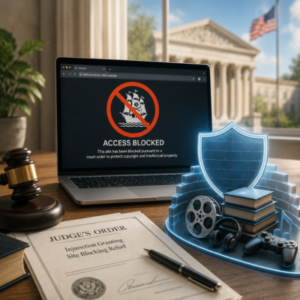
To combat these harms, nearly 60 countries around the world have adopted site blocking measures that stem the tide of illegal piracy and protect consumers, rightsholders, and legitimate distributors of copyrighted works. The site blocking process involves petitioning a court to issue an order to an internet service provider (ISP) to stop websites or online services that are primarily designed or provided for the purpose of infringing copyright from accessing specific markets. The orders are often referred to as “no fault” injunctions, meaning that ISPs are not liable for the infringement taking place on websites accessible over their networks.
The site blocking process works. Peer-reviewed studies have found that when these orders are used at a suitable scale, traffic to blocked piracy websites is reduced by 80-90% percent while use of legitimate digital services goes up.
Unfortunately, the United States remains a glaring outlier with no site blocking system. That shortcoming has been exploited by foreign-based piracy sites and has led to an explosion of US consumers accessing foreign-based piracy sites. According to piracy analytics firm Dataprot, the United States is far and away the number one consumer of pirated works in the world—accounting for over 17.3 billion visits to piracy sites in 2024—far outpacing countries like China and Russia. But the good news is that we should not be number one for long.
There is growing momentum in Congress to finally enact this highly effective tool to address online piracy. A bipartisan group of lawmakers has been working on enacting judicial site blocking legislation for the last two Congresses, with Rep. Zoe Lofgren (D-CA)—herself once a blocking skeptic—introducing the Foreign Anti-Digital Piracy Act (FADPA) to wide acclaim. Rep. Darrell Issa (R-CA), Chairman of the House Judiciary Committee’s IP subcommittee has also stressed the need for Congress to adopt site blocking legislation and has convened important stakeholder roundtables and recently led a hearing focused on site blocking and other issues related to intellectual property theft.
During that hearing, the subcommittee heard from a panel of expert witnesses who all recognized the urgent need to adopt more effective enforcement mechanisms. The hearing featured nearly every member of the subcommittee, as well as the chairman and ranking member of the full Judiciary Committee, expressing strong support for antipiracy and site blocking measures. Chairman Issa also said that he wants site blocking legislation to move “under his watch,” which is notable because his term is coming to an end and he will not be running for reelection.
Site blocking legislation is also moving forward in the Senate where Senators Thom Tillis (R-NC), Chris Coons (D-DE), Marsha Blackburn (R-TN) and Adam Schiff (D-CA) released a discussion draft of an online antipiracy bill last year and continue to prioritize the adoption of a site blocking system. With all this activity and interest in getting site blocking legislation enacted this session of Congress, there is optimism we’ll see legislation introduced and move swiftly through both bodies.
After years of considering site blocking legislation, the number of opponents has dwindled to a few whose arguments consist of stale (and demonstrably false) warnings about website blocking “breaking the internet.” The reason there is strong bipartisan support amongst lawmakers and widespread support among stakeholders is that the draft bills include clear due process protections and guarantees that the internet remains free and open.
The draft bills clearly immunize ISPs for actions taken pursuant to site blocking court orders directing them to limit access to adjudicated large-scale foreign piracy sites—and rightly so. ISPs are on the receiving end of judicial blocking orders not because they’re at fault for the underlying piracy, but because they’re best situated to protect US consumers and markets from foreign bad actors that typically ignore US court orders directing them to cease illegal activities.
Some have also argued that blocking orders will somehow result in legitimate, non-infringing sites being blocked, and they cite to isolated incidents in foreign jurisdictions. But US lawmakers have learned from how other countries have implemented site blocking, and every version of legislation under consideration only allows blocking orders to issue where there is detailed evidence that the target website is overwhelmingly dedicated to unlawful online piracy. Not only that, but both ISPs and the operators of foreign websites would have ample opportunity to contest their inclusion in any order.
The United States has long been a world leader on issues related to intellectual property enforcement, but it has been surpassed by other countries in adopting and implementing this important antipiracy tool. It’s time for that to change and for Congress to provide express authority for a judicial blocking regime that will give copyright owners what more than a decade of experience around the globe has shown is an effective tool to address piracy.
Kevin Madigan is Senior Vice President for Policy and Government Affairs at the Copyright Alliance where his work focuses on the intersection of copyright law, online piracy, and artificial intelligence.

