Published on Sep 12, 2026
By Joel Lauren Thayer
Insurers are raising 2026 marketplace premiums by an average of 26% nationally. This ultimately will increase healthcare costs for everyday Americans across the country. Indeed, 10 states have seen increases above 30%, with Arkansas topping the list at 67%.
States are responsible for finding ways to lower those costs for their citizens. But there is another, unaccountable organization that impacts insurance costs and practices, while also serving as a de facto market regulator and gatekeeper. The rules that matter most to everyday Americans are written by a private, tax-exempt association in Delaware. It’s called the National Association of Insurance Commissioners, or NAIC.
NAIC is a private standard-setting body that functions as a de facto national insurance regulator. The Government Accountability Office describes the NAIC as “a private, tax-exempt organization whose membership is made up of state insurance regulators.”
Yet through its accreditation program, the NAIC compels all 50 states to adopt its model laws and treat its internal manuals as binding. They do so without any of our traditional notions of due process or accountability, such as a notice-and-comment rulemaking, or cost-benefit analysis, and, of course, no judicial review once it makes these consequential decisions.
So why do states accept it as an authority? NAIC’s leverage over them.
States are not technically forced to participate. But as University of Minnesota law professor Daniel Schwarcz documents in Is U.S. Insurance Regulation Unconstitutional?, the NAIC has built the accreditation program so that non-accredited states lose the ability to rely on other states’ examinations.
Put in plain English, this means any insurer domiciled in a non-accredited state would quickly relocate elsewhere, taking jobs and tax revenue with it. Unsurprisingly, every single state is accredited. So every state plays along.
That arrangement has always been awkward, but we are veering towards it being dangerous, given the NAIC’s latest action.
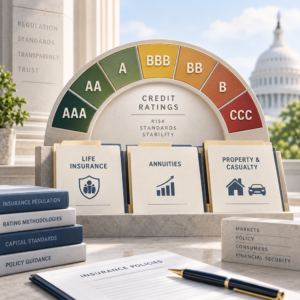
The NAIC’s Credit Rating Provider Working Group has proposed a “Due Diligence Framework” that would let the NAIC unilaterally decide which independent credit rating agencies count and which asset classes are hit with higher capital charges. This is the precise power over rating methodology that Congress explicitly withheld from the SEC itself under the Securities Exchange Act. So, not only is a private trade group amassing more authority than a federal regulator, but it’s doing so with complete opacity. Their lack of accountability can create instability in the market, which could mean more over-charges and raises consumer costs. For instance, if capital charges jump on insurers’ current asset classes, insurers will either raise annuity and life premiums, cut crediting rates, or pull products from the market; all of those costs get passed straight to the insured.
NAIC’s process is also complicated due to significant conflicts of interest within its committees. There are current members of the NAIC committee writing these valuation rules while simultaneously working with private-equity-backed insurers like Athene, the very companies whose asset valuations the rules will govern. For instance, Iowa Insurance Division staffer Carrie Mears works with Athene and participates “in the NAIC’s Valuation of Securities Task Force, which governs how insurers value the assets on their balance sheets.” Mears also represents Commissioner Ommen as chair of the NAIC’s Invested Assets (E) Task Force, which has direct oversight over the working group that administers the Framework. That’s a textbook definition of regulatory capture.
When a closed-door working group can override professional raters with no hearing and no appeal, real capital is not determined by market forces but rather by requirements created by people with a stake in the outcome. Worse, those costs aren’t borne by the insurers; instead, they get passed onto consumers through premiums. This hurts American families directly.
The practical effect of this lack of oversight transforms an internal NAIC whitepaper into a de facto state law, because it becomes binding only through its accreditation regime.
This is the same type of accreditation mechanism that legal scholars, like Daniel Schwarcz, have argued raises serious separation-of-powers problems. Professor Schwarcz states that the NAIC “violates basic separation of powers and non-delegation principles embedded in every state constitution.” And he’s right, especially with respect to non-delegation. For the unfamiliar, the Constitution prohibits Congress from giving away its lawmaking powers to the executive branch, administrative agencies, or private groups. State constitutions, too, have the same non-delegation principles. NAIC’s own government-affairs brief explains, accreditation “provides the impetus for states to adopt in a consistent manner the NAIC model laws, regulations and requirements” that make up the national solvency framework.
Irrespective of how one feels about insurance companies or their pricing, we all can agree that an entity with absolutely no accountability to citizens doing the pricing is unacceptable. Those are practices reserved for a legislature. Or a regulator. Or a court. This is especially concerning given the NAIC’s very well-documented conflicts.
How can we assume the NAIC upholds the public interest it claims to serve when it doesn’t hold itself to basic ethical standards?
These conflicts with industry also create the potential for anti-competitive collusive acts that may give rise to violations under our antitrust laws. Given that DOJ and the FTC have said competition enforcement should make life more affordable for working families, it is imperative that they examine an unelected organization that is quietly reshaping the important rules behind Americans’ life insurance and retirement products. A working group that lets conflicted non-democratically elected regulators decide which rating agencies to trust and how harshly to treat insurers’ assets lacks safeguards against the capture our antitrust laws condemn. These are the exact kind of concentrated, conflicted powers for which that mandate was written.
The NAIC should withdraw its framework, and federal antitrust regulators should take a hard look at whether an organization this captured gets to call itself a regulator at all.
Joel Thayer is an attorney based in Washington, D.C. with a focus on antitrust and consumer protection.

